Monday, September 7, 2009


We Celebrate Labor Day!


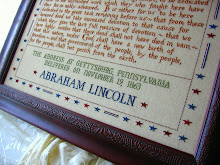
Labor Day, the first Monday in September, honors the accomplishments of working people -- but to be honest, I always associated this holiday with the unofficial end of summer and the beginning of school. But today is a memorable Labor Day for me, a milestone of a 7-month-long project. "272 Words" has been stitched and framed. This blog, however, continues on. After all, President Lincoln's Bicentennial year extends to February 12, 2009 and there's lots to talk about. It's rather a luxury to have an entire blog devoted to one design. I will publish a chart of the design in the coming months -- details to be posted in mid-September, along with stats (design size, framing specs, etc.).

Today's story is told in pictures. Please click on the photos for a close-up view. Your encouraging comments over these last months continue to inspire, going forward into the next chapter of this sampler's life. I very much appreciate your taking the time to visit!

At times friends asked whether I tired of the project. Apart from a bit of physical fatigue (eye strain, finger cramps), I never tired of Lincoln's message. As stitchers, you are well acquainted with the amount of time involved in stitching even a small piece. With each stitch, the prose slowly appears on the linen, letter by letter -- that gives us time to meditate on each word. The Address unfolded in slow motion, allowing the stitcher time to absorb the depth of Lincoln's message. The Gettysburg Address is a national treasure. Thank you for joining me today.

"272 Words" -- The Gettysburg Address


"Four score and seven years ago, our fathers brought forth on this continent a new nation . . ."


". . . conceived in Liberty and dedicated to the proposition that all men are created equal."


"Now we are engaged in a great civil war, testing whether that nation or any nation so conceived and so dedicated can long endure. We are met on a great battle-field of that war. We have come to dedicate a portion of that field, as a final resting place for those who here gave their lives that that nation might live."


"It is altogether fitting and proper that we should do this."


"But, in a larger sense, we can not dedicate -- we can not consecrate -- we can not hallow -- this ground. The brave men, living and dead, who struggled here, have consecrated it, far above our poor power to add or detract."


"The world will little note, nor long remember what we say here, but it can never forget what they did here. It is for us the living, rather, to be dedicated here to the unfinished work which they who fought here have thus far so nobly advanced. It is rather for us to be here dedicated to the great task remaining before us . . . "


". . . that from these honored dead we take increased devotion to that cause for which they gave the last full measure of devotion -- that we here highly resolve that these dead shall not have died in vain -- that this nation, under God, shall have a new birth of freedom . . . "


". . . and that government of the people, by the people, for the people . . . "


". . . shall not perish from the earth."


Wrought by Elizabeth C. Gorski, in Honor of
President Abraham Lincoln's Bicentennial Year
New York City
July 4, 2009

Saturday, August 29, 2009


"In the end, it's not the years in your life that count.
It's the life in your years" ~ Abraham Lincoln

During his 56 years on Earth, Abraham Lincoln had only 18 months of formal education. One of the most influential thinkers in American history, Lincoln was essentially self-taught. In addition to his reading of the law, the scope of Lincoln's interests ran the gamut -- from Aesop's Fables to the First Six Books of Euclid and everything in between.

The drive to learn and reason through a mastery of the written word is evident in Lincoln's prose. Like The Gettysburg Address, his writings were built on a foundation of classical knowledge and plain old common sense.

In the previous post about photographs of Lincoln at Gettysburg, Liz from Philadelphia reports that additional images may have been discovered. Wow, the President's stovepipe hat is quite prominent in the photo on the right. Thanks, Liz, for the clarification!

Now, one more thing about voracious readers: I've noticed (or maybe it's my imagination) that stitchers tend to be serious readers. Perhaps the same powers of concentration used in reading are applied to stitching -- such as, the ability to focus on a task for hours on end.

Or . . . is it simply that stitchers are a highly-evolved form of intelligent life, super-ably equipped to perform complex tasks beyond the ken of the General Population?

Yeah, I think that's it. :)

Thursday, August 27, 2009


"Getting One's Ducks In A Row . . . . again . . . "

One of the pleasures of this bicentennial project has been the background research on Abraham Lincoln and his presidency. For instance, I never knew that there is no photograph of Abraham Lincoln with his wife, Mary Todd Lincoln. Yes, there are composite paintings of the couple, but no photograph.

Another image that doesn't exist is a photo of Lincoln delivering the Gettysburg Address. It has been reported that the photographer at Gettysburg had assumed he had ample time to set up for the photo. After all, the previous speaker, Edward Everett, spoke for two hours. Plenty of prep time . . . right?

Little did he know that the window of opportunity was only three minutes. The Gettysburg Address -- hailed for its elegant brevity -- was delivered in 1863, well before our point-and-shoot camera technology. The poor photographer was still setting up his camera as Lincoln recited the closing words -- "shall not perish from the earth" -- and sat down. Oh-oh. (I'm not sure of the authenticity of the story; it may be apocryphal, but it's a fascinating anecdote.)

I wonder how the photographer's boss reacted when he heard the news. We've all had bad days at work but . . .

This is the only known photo of President Lincoln (he's in the center) at Gettysburg -- taken upon his arrival at the burial ground. And here's an illustration of Lincoln's delivery.

Well, here's a photo that exists. It's Harley, the Spokesdog at Where Victoria's Angels Stitch. He was on hand when I delivered the sampler for framing. Harley's taking a well-deserved dog nap -- it's tough being a spokesdog!


WVAS is a beautiful family-run needlework shop in Clifton, New Jersey. Tawny and Don, the proprietors, are the bomb! We refer to WVAS as New York City's official cross stitch shop -- because there's nothing like it in NYC. If you're in the New York/New Jersey area, please drop by the shop. You'll love the homey atmosphere and wide variety of products.

Have a good Thursday eve. I'm going to recharge the batteries in my camera. :)

Until next time . . . ciao!

Monday, August 24, 2009


"The Gettysburg Address is not a pangram . . . "

Breaking news from the city desk at The American Stitcher: "The Gettysburg Address is Not a Pangram"

This makes me very happy.

What's a pangram? It's a sentence or piece of writing that uses all 26 letters of the alphabet. You know, like . . . "The Quick Brown Fox Jumps Over A Lazy Dog."

In certain corners of the literary world, scorekeepers judge works based on their pangrammatic features. A reductio ad alphabetum . . . reducing prose to component letter features, rather than the literacy of the words themselves. I never bought the whole pangram thing, as good writing is remembered for reasons that transcend individual letters.

Pangrammatic sentences are useful for keyboard testers, but to extend it any further would be akin to checking whether Beethoven crammed all the tones of one key into the first stanza of his Fifth Symphony.

Scholars have challenged the story of Lincoln's last-minute preparation of the Address -- like the account of his jotting the Address on the back of an envelope during the train trip to Gettysburg. Rather, evidence suggests that Lincoln took his charge seriously (as was his practice) and prepared drafts of the Address well before his trip, knowing there would be little time to write the speech during his trip or upon his arrival in Pennsylvania.

Not surprising. Good writing -- especially good, terse writing like this 272-word Address -- evolves from numerous drafts which are honed and refined. Those characteristically-slim volumes of Strunk & White tell the story, short and sweet -- S&W practiced what they preached. It's easier to write longer than shorter. It reminds me of a quote from a correspondent/essayist whose name I can't remember: "I apologize for this long letter. If I had more time, it would have been shorter."

And so, kudos to great writing that is driven by carefully-chosen words and not individual letters.

Sampler update: The sampler is in the capable hands of our framing expert, and so I've enlisted other samplers as substitute models for the blog essays . . . like the one above which provides the pangrammatic alphabetic display. Pangrams are perfectly fine for samplers that feature alphabets. :)

Last week Lili asked about the logistics of framing a cross stitch design on linen. The linen is stretched over a piece of acid-free foam board, and then secured (laced) in the back almost corset-style, evenly stretching the fabric across the board. I'm searching for a good on-line tutorial to link to . . . it's an interesting process. I'll get back to you on that.

Talk to you soon . . have a good Monday eve! Cheers, friends!

Wednesday, August 19, 2009


"The Other Gettysburg Address on November 19, 1863"

The first Gettsyburg Address preceded President Lincoln's by about two hours. Delivered by Former Secretary of State Edward Everett, the first oration on that day lasted 2 hours, as opposed to Lincoln's 3-minute address. Everett, a distinguished Boston orator in the tradition of Daniel Webster, opened with these words:

Standing beneath this serene sky, overlooking these broad fields now reposing from the labors of the waning year, the mighty Alleghenies dimly towering before us, the graves of our brethren beneath our feet, it is with hesitation that I raise my poor voice to break the eloquent silence of God and Nature. But the duty to which you have called me must be perfomed; grant me, I pray you, your indulgence and your sympathy.

Everett's 13,607-word speech is quite a contrast to Lincoln's 272 words. A Mahler Symphony followed by a Chopin etude. Or a Dickens novel followed by an Emily Dickinson poem. What a juxtaposition of scale! But art assumes all sizes, and the two men, each in his own way, honored the fallen soldiers at Gettysburg with grace and humility.

The next day's correspondence between the two men began with Everett praising Lincoln's brevity, to which Lincoln replied: "I am pleased to know that, in your judgment, the little I did say was not entirely a failure."

I'm trying to remember the last time I heard today's crop of politicians speak with such humility and elegance.

We have new followers to this blog - welcome all! A few of you have asked about "272 Words" -- will there be a chart? The sampler is still a work in progress and I'll post the answer here by mid-September. I'd like to make the decision after the piece is framed. Your inquiries and kind words have inspired beyond measure.

Back to the matter at hand . . . the sampler is on its way to the framer, and, for the first time in my stitching life -- I hated parting with the linen! Usually there's a happy dance, but not this time. That piece of linen has been a part of my daily life for months. No more tweaks or color changes. No more frogging, reconfiguring, re-stitching. It's time to let go.

Anyone interested in stitching the first Gettysburg Address -- Mr. Everett's -- on linen? It's a mere 13,607 words. :)

I'm taking a couple days' break from stitching, starting tonight . . . can you hear the Apple Martini being made? I hope you'll indulge in a cool drink as well . . .

Cheers, see you in a few days!

Wednesday, August 12, 2009


"There's no 'I' in team . . . or the Gettysburg Address . . . "

Imagine that. In his address at Gettysburg, Abraham Lincoln never uses the personal pronoun "I." He uses "we" throughout. Wow, that's quite an accomplishment for an orator, especially a politician. No wonder these words endure. His priority was to preserve the union, that the nation "shall not perish from the earth." The entire Address has an inclusive feel, that Americans (the "we") were all in it together.

I apologize for my absence these last few weeks. The work schedule took over and the weeks flew by. Liz from Philadelphia recently visited and we toured the town in a whirlwind, with a bit of nostalgia. She and I met as freshmen at Barnard College (same dorm floor), and we've been friends ever since.

Liz gave me a wonderful souvenir from the Betsy Ross House in Philadelphia -- a Betsy Ross Thimble. There's Betsy in the photo, stitching the flag, with the sampler as a backdrop. A thimble is the perfect prop -- I just love it. Thanks, Liz!

It's a good thing that Betsy Ross referred to herself as "Betsy" and not "Liz" (her given name was Elizabeth) -- otherwise this post would be intensely confusing, lol!

Isn't it fantastic that a stitcher plays a key role in the founding of this nation?

Betsy Ross is a Founding Mother, an American icon, a revolutionary figure -- a stitcher!

Saturday, July 11, 2009


"It Was Written In The Stars . . . "

In 1930, Ruth Wakefield of Whitman, Mass. mixed up a batch of cookie dough, not realizing tht she'd run out of baker's chocolate. The dough was already made, and Ruth had to rush the cookies in the oven to serve at the Toll House Inn -- a business she operated with her husband, Kenneth. In an act of improvisation that altered the course of baking history, she quickly threw in some chopped-up semi-sweet chocolate bits, expecting them to melt into the batter when baked. But when she removed the cookies from the oven, the semi-sweet bits hadn't melted into the dough. Ruth's guests loved the new chocolate-chunk cookie and the Toll House Cookie was born.

Now, I'm not comparing my work with Ruth Wakefield's ground-breaking invention, but I had my own "Ruth Wakefield Moment" last week. As I was finishing the sampler, I discovered, with horror, a terrible mistake. I had planned to stitch in 50 stars -- one for each state -- in the border. When I finished the entire border (hours and hours of stitching), and counted the stars, just to make sure . . . I counted only 48.

I hope my neighbors weren't too inconvenienced by the blood-curdling scream that followed.

What to do? Rip out some of the bars and sew in the stars? Or . . . find a place for the two extra stars in another area of the sampler. And that's how two red stars became celestial bookends for ABRAHAM LINCOLN's name. I had originally planned other design elements to flank Lincoln's name, but it seemed to be written in the stars . . . this was meant to be.

I like seeing Lincoln's name in stars. It befits the office of an executive, the Commander-In-Chief. It's a very simple configuration, plain and straightforward, like Lincoln himself. I was aiming for something solemn, respectful, in keeping with tone of the Gettysburg dedication.

And here's the final stitch back on July 3rd, the fiftieth star . . .


In planning the second phase of the sampler prep, I chose Labor Day, September 7, for the final reveal of the framed piece . . . another national holiday that coincides with a Grand Slam tennis tournament (The U.S. Open, here in NYC, this time). This allows plenty of time to "proofread" the sampler, make minor changes/corrections and deliver it for framing over the summer.

I would be a complete disgrace if I -- a puzzlemaker in a parallel life -- misspelled a word of the Gettysburg Address. I'd never live that one down! That's why I'm proofreading in a slightly obsessive way. And since "misspelled" is one of the most misspelled words in the English language . . . one can't be too careful.

See you in a few days, and enjoy the weekend. Thanks again for visiting on July 4th. Your comments mean the world to me. Ciao!